
Sarah Wilson
Housing Account Manager — Wordnerds
Hosted the Predict Your C Rating webinar this playbook is built from.
Social housing · consumer grading
Wordnerds read every published consumer-grading judgment to date—alongside 270 elements of tenant sentiment across 18 housing associations—to find what the Regulator of Social Housing actually rewards. The pattern is clear: C1 isn't won on headline repair stats. It's won on whether you can show you hear every tenant and act on what they tell you.
This playbook maps the four pillars the regulator keeps naming onto the data you already hold—so you can find your weakest pillar before an inspector does.
Housing Account Manager — Wordnerds
Hosted the Predict Your C Rating webinar this playbook is built from.

Research Manager — Housemark
Brought the sector benchmarking behind the C1 and C3 patterns.

Co-founder — Wordnerds
Led the sentiment analysis across the Wordnerds × Housemark benchmark.

Head of Data and Insight — Curo
Shared how a C1 organisation runs complaints learning and an evidence-based action loop.
Published · Last updated
Most landlords think the C grade is about the metrics. It isn't—the regulator is grading the system that produces the metric. This guide maps the regulator's own published language onto the data signals you already hold.
Three years into the new consumer-grading inspections, the language the regulator uses to award C1 is converging hard. We read every published judgment to date alongside 270 elements of customer sentiment across 18 housing associations, and pulled out four recurring pillars: Data triangulation, Root cause resolution, Omni-channel listening, Evidence-based action.
Read it through and you'll have a clear picture of which pillar your organisation is strongest on, which is your largest gap, and the five practical first moves that would close it.
The regulator is grading the system that produces the metric, not the metric itself. Wolverhampton hits 95% on repairs and lands at C2; BCP Council, with lower headline KPIs but a transparent self-referral on fire safety, lands at C1.
The regulator isn't grading your repairs—it's grading whether you can prove you listened. The 13 May 2026 batch sharpened the pattern. Milton Keynes reports 99% routine and 96% emergency repairs on time—and received C2. Salford has effective repairs and a proactive damp-and-mould approach—and received C2. London Borough of Islington had what the regulator called "a fair and respectful culture towards tenants"—and received C3, because the data behind the culture wasn't there.
Strong operational performance matters. But on its own it doesn't get you to C1. Predictive data—the kind that triangulates what tenants say with what your operational systems record—is the early-warning system that lets you find your weaknesses before the regulator does.
Four Standards came into force on 1 April 2024 under the Social Housing (Regulation) Act 2023. Every consumer-grading inspection is built on them.
Read the published judgments side by side and four recurring noun phrases stand out, in near-identical language across very different organisations. These are observation, not invention—each pairs the regulator's verbatim language with the Wordnerds × Housemark sentiment evidence and a self-check.
The regulator grades whether you cross-reference multiple data sources against one another—not whether you hold data, report it, or even collect it. The verb is triangulating.
Stockport (C1) has 1,300 tenants in regular consultations through a customer-voice membership group, alongside a complaints advisory panel—several listening surfaces read together. Hammersmith & Fulham (C1) runs a monthly complaints learning board alongside performance reported in both digital and non-digital formats.
One C2 local-authority landlord collected information about tenants at sign-up that was "incomplete and not routinely updated". The pillar fails not because there's no data, but because what's there is stale and not joined up.
In the Wordnerds × Housemark benchmark—270 customer-experience elements across 18 housing associations—when tenants self-mentioned mental-health challenges in their TSM free text, C1 organisations scored on average 10 sentiment points higher in how they handled the conversation. A vulnerability flag isn't enough: it must be event-stamped, time-varying, and joinable across ASB, repairs and complaints.
Can you cut your TSM scores by recorded vulnerability flag? By tenure length? By stock condition? If the answer is no on any of those three, the regulator's triangulation question is sitting in front of you, unanswered.
"RSH is seeing evidence through inspections of landlords using and triangulating all of their data to pre-empt issues, facilitate challenge and continuously improve."
— Regulator of Social Housing
Across the C1 judgments the regulator returns to one verb: learn. Not "we logged the complaint", not even "we resolved it"—but "we found the root cause linking a cluster of complaints, and did something about it".
At Curo (a C1 organisation), Ed Bramall's team found that aggregating complaints up to a "repairs" category hid the work—most complaints are always about repairs. The useful unit was finer: plumbing versus electrical, timeliness versus communication. Each cluster had a different root cause, and unlocked a different action.
The Housing Ombudsman's damp-and-mould Spotlight made the failure mode explicit: landlords treating damp as a resident problem when it was a building problem. In the Awaab Ishak case, staff attributed mould to the family's bathing and cooking habits; the landlord later admitted it "got that wrong".
In the benchmark, C1 organisations' resolution language clusters around the type of issue—plumbing leak, electrical safety, communication—not around blame for the customer. C2s and C3s show more sentiment around explanation and pushback. Across thousands of complaints, that's the difference between solving a problem and handling a complaint.
When complaints cluster, do you trace them to a root cause, or close the ticket? If the latter, you have a complaints process. You don't yet have a learning process.
"Learning from complaints is systematically captured, shared with tenants through the website and other customer communications, and used to drive service improvements."
— Regulator of Social Housing, Stockport C1 judgment
C1s have both formal and informal channels—the regular survey, the official complaint and the scrutiny panel, plus the chat with a housing officer and the line added to a repair note. Listening across channels means listening across surfaces, digital and non-digital.
Stockport's 1,300-tenant customer-voice group is one channel; its complaints advisory panel another; its website-published learning a third; its TSM survey a fourth. The verdict wasn't "Stockport has a survey"—it was that Stockport has several connected ways for tenants to be heard.
One C2 landlord posted 99% routine and 96% emergency repairs on time—well above sector norms. The regulator didn't penalise the metrics; it penalised the listening architecture: "most of these opportunities have only been developed over the past 12 months and need to be further developed". Maturity is graded, not just presence.
Our analysis revealed a cascade: when digital-navigation sentiment was high—customers could find what they needed when they needed it—they were more likely to feel informed; and when they felt informed, they were more likely to trust the landlord. Trust is a leading indicator: it moves before satisfaction does.
How many tenant-feedback channels are you actively reading, beyond TSM and complaints? If the answer is fewer than three, you're listening through a narrow channel.
"A range of formal and informal ways in which tenants influence the organisation."
— Regulator of Social Housing, Places for People C1 judgment
Every C1 judgment references the closed loop: tenant feedback in, service change out, reported back to the tenants who fed it in. Without that closure, the first three pillars aren't enough.
Curo's action tracker is just a SharePoint list—the system around it is what counts. Analysis identifies an issue; the team takes it to directors; actions are logged with owners and timescales; progress is reviewed; outcomes are reported into customer-feedback reports and board reports. The loop is closed by discipline, not by a platform.
In one C2 judgment the regulator wrote that the landlord had "limited evidence of how it was using the information it holds to assess whether services deliver fair and equitable outcomes for tenants". The data exists; the action loop does not.
Curo's data warehouse brought together customer, property, transactional and complaints data; the missing piece was the qualitative dimension—the words customers use. The complaints learning report, built with Wordnerds, sits on top of the warehouse and produces the categorised free-text analysis the action tracker consumes.
How does a tenant who fed back six months ago find out what happened? If the answer is "they don't", your evidence-based action loop is open at the tenant-facing end.
"The views of tenants have influenced how it delivers services, and improved outcomes for tenants are clearly evidenced and reported."
— Regulator of Social Housing, Golden Lane Housing C1 judgment
Eight judgments in one day—four C1s, two C2s, one C3—sharpened three patterns: a converging "wide range of opportunities" phrase, self-referral proving compatible with C1, and culture without data falling short.

The phrase appears across all four new C1 judgments; the regulator uses identical language because it is naming one observed pattern—multiple, mature, embedded channels for tenant influence rather than a single flagship mechanism.
Stockport self-referred in December 2025 for overdue fire-safety actions; that fact sits inside its C1 judgment. BCP Council's January 2026 C1 followed a June 2024 self-referral. Transparency about weaknesses, paired with credible remediation, counts favourably.
London Borough of Islington was praised for "a fair and respectful culture towards tenants" and still received C3, citing surveys more than ten years old and 13% of homes with collected information. Culture is necessary but insufficient; the operational systems behind it must be present.
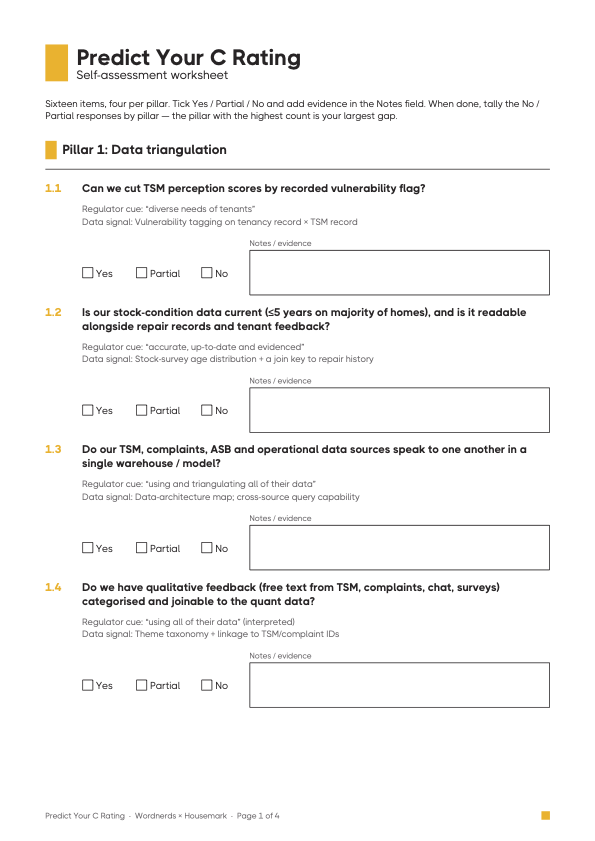
Sixteen items, four per pillar. Score each Yes / Partial / No, and note the data signal behind your answer.
Use it alone or with your team. After completion, tally your No and Partial responses by pillar: the pillar with the highest count is your largest gap; the pillar with the most Yes responses is your foundation.
It deliberately avoids producing a single score or predicting your C grade—the regulator doesn't grade in one number, and neither does this. The purpose is to locate the pillar with the largest gap, so you know where to start.
Social Tenant Access to Information Requirements roll out in two phases—and there are only a few months to the first.
Every private registered provider must proactively publish defined housing-management information across six classes: governance and decision-making, spending, stock management, performance, housing services, and lists and registers. You won't have to create new records—existing information can be redacted where reasonable—but it must be published.
PRPs must respond to individual information requests from tenants, with a statutory internal-review route for refusals completing within 30 calendar days, and unresolved disputes escalating to the Housing Ombudsman. Pillar 3 becomes statutorily visible; Pillar 4 becomes individually testable every time a tenant exercises a request.
"Start small, with what you can get, show the insight you have, and build from there."
— Steve Erdal, Wordnerds
Inventory every document an inspector would expect, and map each to the Consumer Standard it addresses. Mark anything missing, out of date, or unreadable outside the owning team. Aim for one document per Standard sub-element—resist over-documentation.
Find data sources that should connect but don't—TSM and complaints, complaints and repairs, vulnerability flags and case data. Pick the missing connection causing the greatest harm, build the join, and look at what emerges.
Choose a single service area—repairs, ASB, or complaints handling—and run one loop end to end: feedback in, categorisation, root cause, agreed action, delivery, and outcome reported back to the tenants who raised it.
Pick a TSM where you fall short of target and publish the trajectory—four to eight quarters—with a one-paragraph commentary on what you've learned and what you'll do. This mirrors the transparency the regulator named in Places for People's C1.
The regulator expects executive directors to speak fluently on TSM scores, trajectory and data quality without deputising to analysts. Multiple C1s reported needing that fluency during inspection itself. Test it in advance—the fluency itself is the pillar.
The consumer grade (C1–C4) is how the Regulator of Social Housing rates a landlord's services to tenants under the Consumer Standards. C1 is the strongest; C3 and C4 signal serious failings. Crucially, the regulator grades the system that produces your metrics—tenant influence, transparency and responsiveness—not the headline KPIs alone.
C1 means services meet the Consumer Standards with no notable weaknesses; C2 means improvement is needed in some areas; C3 means serious failings. A landlord can post strong KPIs and still land at C2—Wolverhampton hit 95% on repairs and received C2, while BCP Council landed C1 with lower headline numbers but a transparent self-referral on fire safety.
From inspection, self-referrals and the Tenant Satisfaction Measures, the regulator judges whether tenants have a wide range of opportunities to influence services, and whether the landlord understands and acts on the tenant voice. Published C1 judgments converge on the same language—multiple, mature, embedded channels for tenant influence, not a single survey.
Yes. The 13 May 2026 batch showed Milton Keynes reporting 99% routine and 96% emergency repairs on time and still receiving C2. The regulator grades the system behind the metric—tenant influence, transparency and how you respond to what tenants tell you—so high KPIs without embedded tenant voice fall short of C1.
Map the regulator's published language onto the data signals you already hold, across the four pillars the judgments keep naming, then score yourself against them. This playbook includes a 16-item self-assessment worksheet—four items per pillar—so you can find your largest gap and your strongest foundation before the regulator does.
A joint Housemark and Wordnerds report mapping your tenant feedback against the C1 and C3 patterns from published judgments. Roughly 30 days end to end.
Dashboard, report and workshop, mapping your tenant feedback against the C1–C3 patterns from published judgments — roughly 30 days end to end. Register your interest and a housing specialist picks up the conversation within two working days.

So you're reading the footer now? Either you ❤️ Wordnerds or you're desperate for something to read. Either way, CX Corner from Wordnerds is the answer. Fortnightly Voice of Customer bombs dropped in your box. Signup 👇 or find out more.