 2025: Losers & Lessons
A look back at the year's biggest customer-experience faceplants, and what the rest of us should take from them.
2025: Losers & Lessons
A look back at the year's biggest customer-experience faceplants, and what the rest of us should take from them.
The Customer Ledger
Every interaction is a credit or a debit — and the customers about to leave stop paying in long before they say a word.
Created 4 June 2026
Hey there,
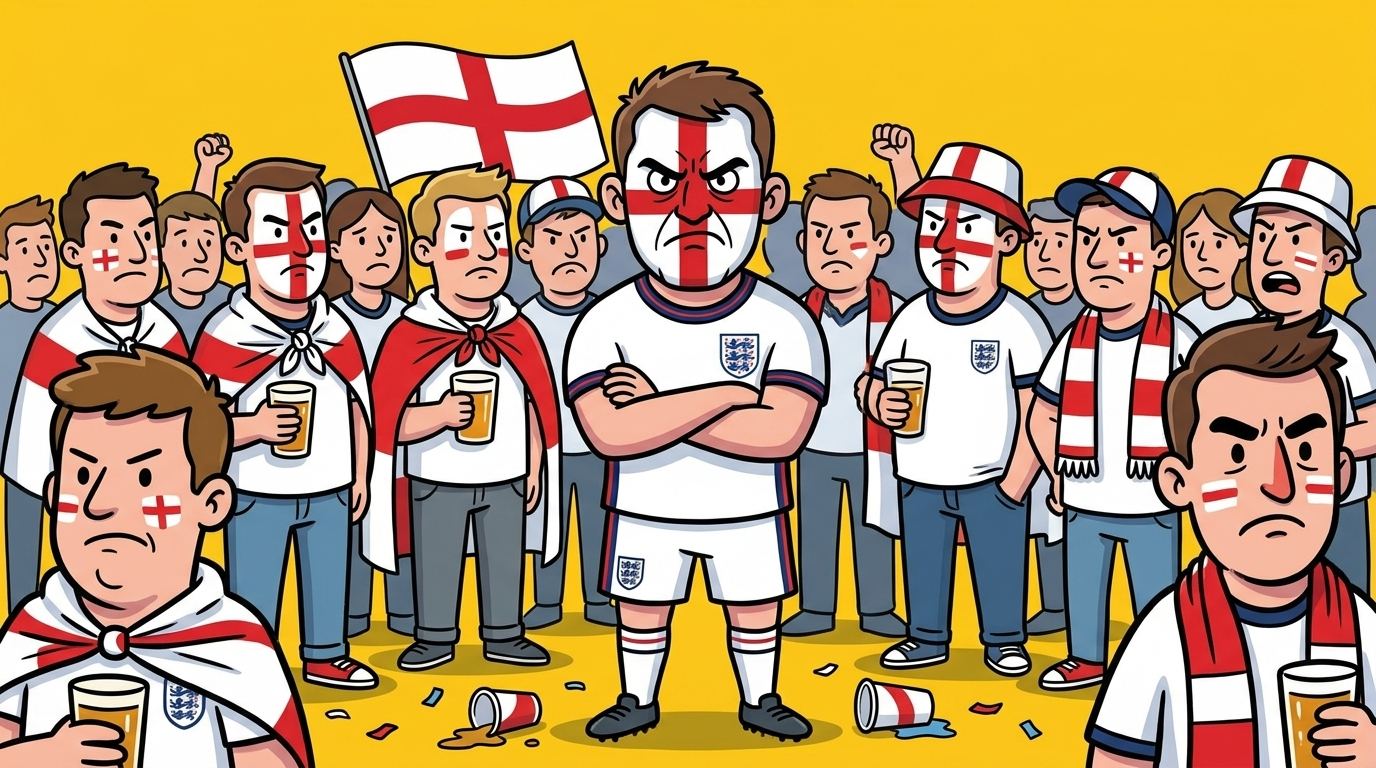
So, are we ready, people? Have you reclaimed your national flag from the far right and hung it out the bathroom window? Got the Panini sticker book, and more swaps than someone your age should really admit to?
Usually by now I'd be in intensive care with an acute case of World Cup Fever, but ever the middle-aged stereotype, I'm grumpier about this one than ever. Don't get me wrong: I love an international footy tournament. Between the 2004 Euros in Portugal and the 2018 World Cup in Russia I think I did the lot. I've lost karaoke battles in Johannesburg, had a kickabout in Red Square, drunk in parks in Donetsk with Ukrainian metalheads, and seen sloths and snakes in the Amazon—all in pursuit of a tournament and the occasional half-decent England performance. (Thank you, Mr Southgate.)
But somewhere along the way the football authorities got more interested in squeezing host nations, broadcasters and—mostly—fans than in the actual football. There are too many teams now. The tournaments are in places I've no desire to visit. And the gouging is wild! $120 for a train trip that a month ago cost $12. Even completing this year's sticker book will reportedly set the average household back £600.
Football's bosses have long run on one assumption: that fans are gloriously irrational, über-loyal, and will turn up come what may—however dear, however difficult, however joyless they make it. For a century they've been right. It feels, finally, like that's being tested.
But the rest of us don't have that luxury. Your customers aren't fans. They don't owe you decades of devotion. There's no fear that this could be your year and what if I don't have a season ticket and miss it? If your product or service isn't spot on, they don't make up amusing chants about the competitors' customers—they leave. Quietly. Which raises a hard question, and it's what this issue is about.
How would you ever know they were about to go?
Not after they've gone. Before. While you can still do something.
This week I put the phone down after a conversation with one of our customers, Lawrence. He's a longstanding CX professional with wide-ranging experience running Medallia and Qualtrics-based VoC programmes for massive corporates like BT to where he is now in regulated industry. He's a data person's data person and has forgotten more about this stuff than most of us will learn.
He described a customer relationship as a running ledger: every good experience a credit, every bad one a debit, and every customer sitting somewhere on a line that runs from advocate to tolerating you to quietly off you to shopping around to gone. The question we were tackling together: at what point on that ledger does someone actually act—and how on earth can we see it coming?
I promised him I'd give the matter some thought and have since gone looking for an answer. Turns out there's a rich, slightly mad seam of research on it that almost nobody in CX talks about. And if that doesn't sound like the perfect set-up for CX Corner, slap me.
First, why you can't see it now
Your instinct is to look at the satisfaction score. Don't. The score is built from the people who replied—and the people who reply are, structurally, the loyal and the trapped.
This is Albert Hirschman's old insight (Exit, Voice, and Loyalty, 1970), sharpened by later work: when customers can't easily leave—or haven't yet decided to—they use voice. They complain, they fill in the survey, they tell you. But the ones edging towards the door tend to go the other way. They take private action: they stop engaging, grumble to a mate, and slip out without a word. Singh's research on complaint behaviour found exactly this—dissatisfied customers often skip complaining to you entirely in favour of quietly bad-mouthing you to everyone else.
We've covered this before—the "silent majority" in issue 46, the high-effort customers who go quiet and vanish in issue 51. This issue is about the mechanism underneath it.
Because the survey isn't a running ledger. It's the closing balance of the customers who haven't left yet. The ones nearest the exit stopped answering a while ago.
.png)
The ledger, and its three laws
Here's what makes the ledger so hard to read off a dashboard: it doesn't behave the way bookkeeping should. Three laws, all counterintuitive, all invisible to your score.
Law one: a debit is not the opposite of a credit. We'd love the books to balance—one good experience cancels one bad. They don't. The psychologist Roy Baumeister reviewed the evidence across just about every field of human life and called the paper, bluntly, "Bad Is Stronger Than Good." The rough exchange rate: a single negative experience takes somewhere between three and five positives to offset. (Yes—this is the loss aversion we banged on about in issue 54, showing up in the relationship rather than the survey question.) Worse, some things can only ever be debits. Get the basics wrong—a billing error, an outage, a safety slip—and no amount of delight buys it back. The research is crystal clear: doing less bad beats doing more good. You cannot delight your way out of a broken promise.
Law two: the tip is a fold, not a slope. You'd expect loyalty to erode gently, in step with service—a bit worse, a bit less loyal. It doesn't. Customers absorb debit after debit, looking perfectly stable, because they're locked in or can't be bothered to move—right up until one trivial thing, the genuinely-last straw, and they drop off a cliff. (There's a whole branch of maths for this—catastrophe theory—but you don't need the equations; you need the picture: flat, flat, flat, gone.) The loyalty looked solid because it was structural, not emotional. And the exact height of the cliff isn't fixed—it's about whether their real need got met. Lawrence told me about a study he ran at BT: customers would happily tolerate a call queue wait of several minutes if their actual question got answered—and turn on a sixpence if it didn't. Same wait. Opposite reaction. The threshold isn't about how long or how much. It's about whether the thing that mattered happened.
Law three: the bigger the balance, the bigger the betrayal. Here's the one that should keep you up at night. Your most loyal customers are not your safest. Researchers Grégoire, Tripp and Legoux titled their study "When Customer Love Turns into Lasting Hate"—and found that customers with the strongest relationships seek the most revenge when you betray them, especially after a "double deviation": a failure, followed by a botched attempt to fix it. They expected better, so the let-down reads as treachery. The patron saint here is Dave Carroll, the musician whose guitar United Airlines broke and then fobbed him off for nine months. He wrote a song. "United Breaks Guitars" racked up millions of views and turned one broken guitar into a global case study in how to torch goodwill. And the nasty sting in the research: anger fades, but avoidance grows. The rage burns out; the quiet, permanent turning-away gets stronger with time.
So how would you actually measure it?
Nobody's cracked this—us included—and anyone who tells you they've got a tidy "ledger score" in a box is selling you something. But the direction is clear: stop reading the closing balance, and start reading the signals that move before the score does.
They're already in your data. Walk the slide from healthy to gone and they're hiding in plain sight:
- Drift. The quiet stuff. Logins tailing off, usage softening, a customer who used to open everything going quiet. Repeated little failures on the basics—two or three in a month on something that can only ever be a debit.
- Effort. The friction signals: someone trawling your cancellation page, contacting you for the third time about the same thing, re-explaining themselves down the phone. This is the Effort Index we built in issue 51—and now you can see where it fits: effort is one type of debit on the ledger. A big one, but one of several.
- The language. Not the score—the words. "Fobbed off." "Gave up in the end." "Nobody told me anything." People tell you they're going long before they go, in calls, chats, emails and reviews. The tone shifts before the number does.
- The silence. The most under-read signal of the lot. The Housing Ombudsman found that roughly a third of dissatisfied tenants don't escalate at all—they've decided it's pointless. Ofwat's research after last year's supply failures found about half of affected customers quietly switched to bottled water—no complaint, no churn signal, just a private little exit from trusting the tap. Silence isn't the absence of data. Silence is the data.
And bin the stale stuff. A glowing score from six months ago does not mean "loyal today"—advocacy has a half-life (about 150 days, since you're asking); weight what's recent. When someone does leave, don't fire a tick-box exit survey with "price / product / other"; have an actual conversation about why, while the trail's warm.
If you think this sounds like hard work, it is. But it's important. So much so that regulators are now mandating it. The FCA's Consumer Duty guidance for 2026 explicitly tells boards to monitor the "silent majority"—the customers who aren't complaining—because absence of complaint is not evidence of satisfaction. When the regulator is telling you to go looking for the people who've gone quiet, the closing-balance era is over.
Any ideas?
We're at the start of thinking about this—trying to measure the run-up to churn rather than performing the post-mortem—we'd love to hear from you. So if it's something you've already considered, we're all ears.
Our opening thesis is that there isn't a perfect ledger to audit, even if we knew how. The data's scattered across channels and departments for most people. The first challenge is a data engineering one. But nevertheless, the running balance surely lives in what your customers actually say—continuously, unprompted, across every channel they use. Reading that, at scale, before the score catches up, is the whole game. It's certainly ours.
Until next time, keep learning.
Pete
P.S. Relationship researchers reckon it takes about five good interactions to offset one bad—the "magic ratio" John Gottman used to predict, with unnerving accuracy, which married couples would divorce. Your customers keep score much the same way. And like an unhappy spouse, the dangerous ones aren't the ones shouting. They're the ones who've gone quiet, started sleeping in the spare room, and are silently, carefully, taking the scissors to your 1988 Marco Gabbiadini original Hummel promotion shirt.
More from CX Corner
2025: Losers & Lessons
A look back at the year's biggest customer-experience faceplants, and what the rest of us should take from them.
 The Great Bifurcation
Service is splitting into cheap-and-automated versus premium-and-human — and the middle is the dangerous place to sit.
The Great Bifurcation
Service is splitting into cheap-and-automated versus premium-and-human — and the middle is the dangerous place to sit.
 Your CFO Thinks You're Making It Up
How to turn “customers seem happier” into a number your finance director will actually sign off on.
Your CFO Thinks You're Making It Up
How to turn “customers seem happier” into a number your finance director will actually sign off on.
