 The Customer Ledger
Every interaction is a credit or a debit — and the customers about to leave stop paying in long before they say a word.
The Customer Ledger
Every interaction is a credit or a debit — and the customers about to leave stop paying in long before they say a word.
The Great Bifurcation
Service is splitting into cheap-and-automated versus premium-and-human — and the middle is the dangerous place to sit.
Created 2 December 2025
Hey there,
We're nearly there, people. Shhhhh… can you hear them?
No, not the sleigh bells—that wonderful, once-a-year, festive sound of the expensive cheeses being unwrapped and the rustle of the Celebrations "tin".
Quality Street, you say? Get you!
For most of us it's only three more weeks before it becomes socially acceptable—nay, obligatory!—to eat our body weight in jalapeño-coated nuts and bust out the 11 a.m. spicy margaritas.
Not you lot in retail, obviously. This doesn't apply to you. Actually, what the hell are you doing reading this? Get back to work, people. MAKE. BLOODY. HAY.
But before we disappear into a Pistachio & Dubai Chocolate coma, let's take stock of what's happened in customer experience this year. Because 2025 has been... well, it's been a lot.
The Year the Service Industry Split in Two
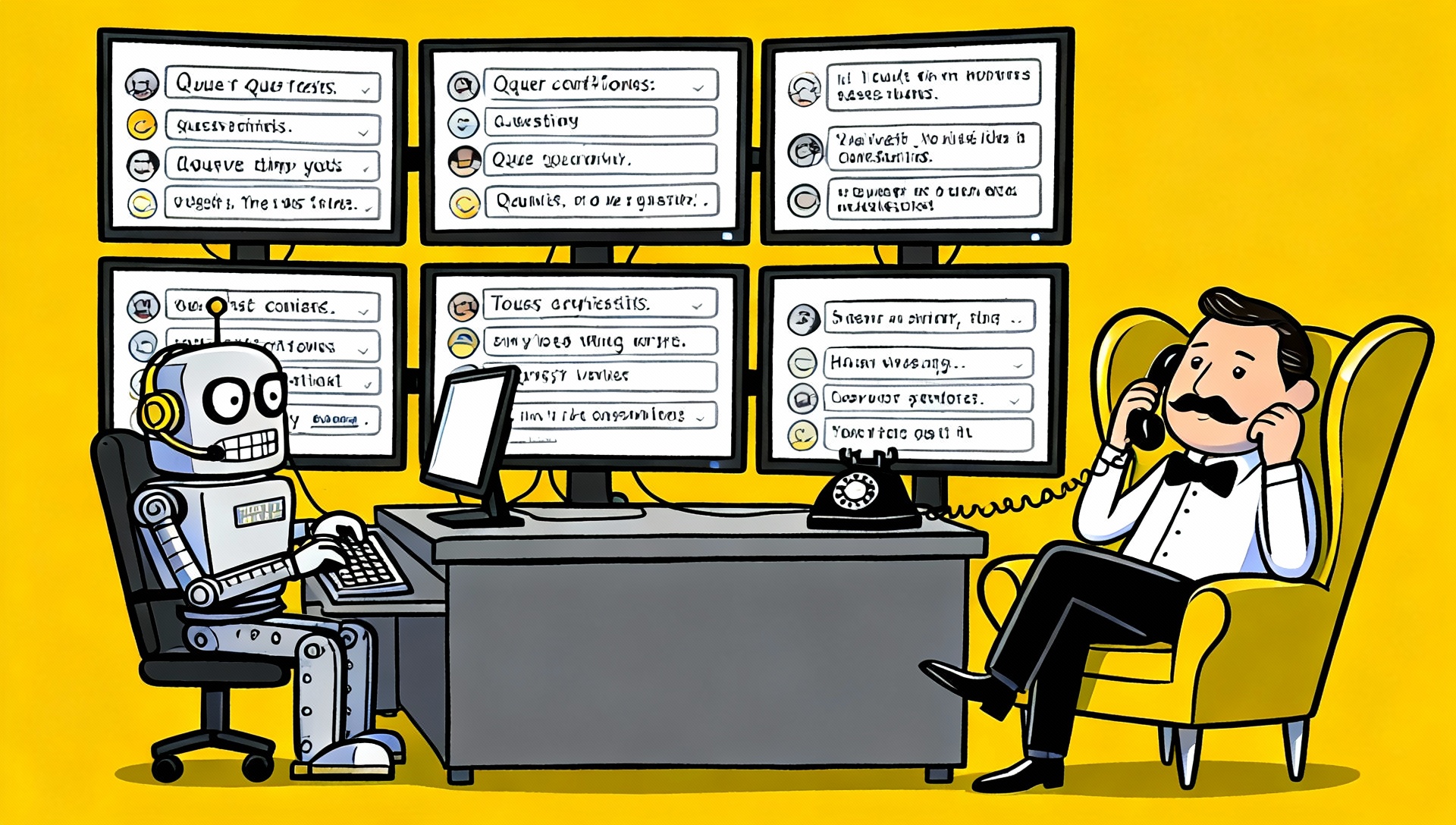
If we had to sum up 2025 in one phrase, it would be: The Great Bifurcation.
We've moved beyond the "pilot purgatory" of Generative AI—those endless 2023 and 2024 board presentations about potential Copilot use cases that never quite worked—into the operational reality of Agentic AI.
These aren't systems that just answer questions anymore. They execute workflows. They make decisions. They process refunds, update ledgers, close tickets, and move on to the next customer without coffee breaks, bathroom trips or opinions on Celebrity Traitors (poor bairns).
And this technological maturation has catalysed something profound: the splitting of the service landscape into two distinct worlds.
On one side, you have the mass market—increasingly served by highly competent, autonomous AI agents that can resolve complex issues (refund negotiations, mortgage adjustments, account changes) without human intervention. Efficiency is the religion. Speed is the sacrament.
On the other side, you have the premium market—where access to an actual human being has been re-priced as a luxury good. Speaking to a person? That'll be £20 a month, please. Or spend more with us. Or achieve VIP status. Human empathy, it turns out, is now a subscription feature.
This isn't just about technology. It's a fundamental rewriting of the social contract between brands and customers. A new class system of service where efficiency is free, but empathy costs extra.
Let us show you what this looks like in practice.
The Tale of Two Strategies
On one end of the spectrum: Klarna.
The buy-now-pay-later giant deployed an AI assistant that at one point handled two-thirds of all customer service inquiries—not "helped with," but completed end-to-end. The numbers were staggering: it did the work of 700 agents, cut resolution times from minutes to seconds, and reduced cost per transaction by 40%. Q3 2025? Record-breaking $903 million in revenue.
Here's why it works: their customers don't want a conversation. They want answers. "Why did my payment fail?" "When is my bill due?" These are transactional queries. No emotional labour required. Just fast, accurate, friction-free resolution.
For mass-market financial services, competent automation beats mediocre human support.
Now, the opposite end: Chewy.
The pet supplies retailer has built a multi-billion dollar empire on something that cannot be automated: feelings.
Chewy empowers its customer service agents to perform what they call "random acts of kindness." When a customer mentions their dog has died, an agent can—without manager approval, without checking a budget—send flowers. Or a handwritten condolence card. Or commission an oil painting of the pet.
These aren't isolated incidents. They're policy. And they generate immense organic marketing. A single tweet about receiving flowers from Chewy after a pet's death can garner 700,000 likes. That's a halo effect no paid ad can replicate.
Chewy's lesson is equally clear: You can automate transactions, but you cannot automate relationships. In the "Human Premium" economy, Chewy offers the premium experience as standard—and earns fierce, irrational, "I will never shop anywhere else" loyalty in return.
Here's the Thing: They're Both Winning
Spectacularly.
Klarna's stock is up. Chewy's customer lifetime value is through the roof. They've just chosen opposite ends of the service spectrum—and that's exactly the point.
The Human Premium Is Real (And It's Being Priced Accordingly)
Here's what's actually happened: AI has driven the marginal cost of standard transactional service toward zero. Which means the value of human empathy, critical thinking, and emotional intelligence has skyrocketed.
Brands have responded by restructuring their service models to gatekeep human access.
Revolut's "Ultra" plan explicitly markets "Priority customer support with 24/7 human access" as a premium benefit. Standard tier? You're talking to a bot. Maybe escalated to email. Eventually.
This is the reversal of the democratisation promised in the early internet era. Where digital channels were once the "alternative" to the call centre, the live agent is now the "alternative" to the digital default—available only to those with the economic means to bypass the algorithm.
Your customers have largely accepted this bargain. For now. They'll tolerate a bot for password resets, simple queries, basic transactions. Speed beats empathy when the stakes are low.
But when things get complex? When they're emotional, high-stakes, confusing? (A lost pet. A disputed charge. A medical emergency.) The tolerance for automation evaporates instantly.
And if you've hidden your phone number or put it behind a paywall, you better hope your digital channels are bloody perfect. Because when they fail—and they will—you're about to have a reputational crisis on your hands.
But Here's the Plot Twist
Even in this bifurcated world, the smartest companies aren't actually choosing.
Like all of these things, Klarna's story is an oversimplification. The AI chatbot struggled with complex, nuanced, or emotionally sensitive issues—fraud, disputes—which require human judgment and empathy.
Klarna has since acknowledged that heavy reliance on AI led to declining service quality. They've started hiring more human agents and reassigning staff to customer support. The hybrid model is here.
The learning? You actually NEED both. You just need really clear (automated) triage to ascertain which is a transactional issue and which requires human intervention. Then quarterback accordingly.
Remember how young this technology is, and how fast it's progressing. The direction of travel is clear: as chatbots improve and people get more comfortable, the easy transactional stuff will get eaten by automation. But the complex, emotional stuff? That's staying human.
So What Does This Mean For You?
If you're a CX leader reading this, the question for 2026 isn't 'efficiency or empathy?'
It's simpler: Do you know which customers need which?
Because here's what Klarna's pivot teaches us: you can't just automate everything and hope for the best. You need genuinely competent AI for the transactional stuff ("When's my payment due?") AND accessible humans for the complex, emotional, high-stakes stuff ("Someone's fraudulently used my account and I'm terrified").
The trick—the thing that separates the winners from the losers—is intelligent triage.
Can you tell the difference between a customer who just wants a fast answer and one who needs a human conversation? Can your systems route accordingly? And when automation fails (and it will), does your human fallback actually work?
Most importantly: are you learning from what your customers are already telling you?
Because they're not hiding it. It's all there in the transcripts, the chat logs, the complaint emails. "I've been on hold for 45 minutes." "The chatbot keeps giving me the wrong information." "I just need to speak to a person."
If you're an Insights person, this is where it gets interesting:
How can you leverage AI—not to replace humans, but to understand at scale what your customers actually need? To map their emotional states, their real Jobs-to-be-Done, their tolerance for automation vs. their cry for human intervention?
That's the game-changer. Not picking a lane. Understanding which lane each customer needs, in real-time, and delivering it.
And since it's Christmas, and we're the kind of friendly, neighbourhood Wordnerds that like to spread some real joy at this time of year, our Customer Success team is running a webinar next Tuesday to show you exactly how to do this.
They'll be joined by Niek de Rijcke from 5-star hotel chain, the Dorchester Collection, to demonstrate how some of the world's most premium brands balance efficiency with empathy—and use AI to figure out which customers need which.
I know, we’re the ones who really know what you want this Christmas...
Until next time, keep learning.
Pete
Next week's BONUS issue: The cautionary tales of 2025—when AI goes wrong, when service collapses, and when the TikTok algorithm becomes your worst nightmare. Air Canada's chatbot liability disaster. Telus's customer service abyss. Disney's complexity creep. It's going to be glorious.
P.S. If you're in social housing, this bifurcation hits differently. Your residents can't "choose" another provider, which means you can't hide behind a premium tier. You need both efficiency AND empathy at scale. That's where predictive analytics come in—spotting damp and mould issues in maintenance requests before they become legal nightmares. Want to know more? Let's talk.
More from CX Corner
The Customer Ledger
Every interaction is a credit or a debit — and the customers about to leave stop paying in long before they say a word.
 2025: Losers & Lessons
A look back at the year's biggest customer-experience faceplants, and what the rest of us should take from them.
2025: Losers & Lessons
A look back at the year's biggest customer-experience faceplants, and what the rest of us should take from them.
 Your CFO Thinks You're Making It Up
How to turn “customers seem happier” into a number your finance director will actually sign off on.
Your CFO Thinks You're Making It Up
How to turn “customers seem happier” into a number your finance director will actually sign off on.
